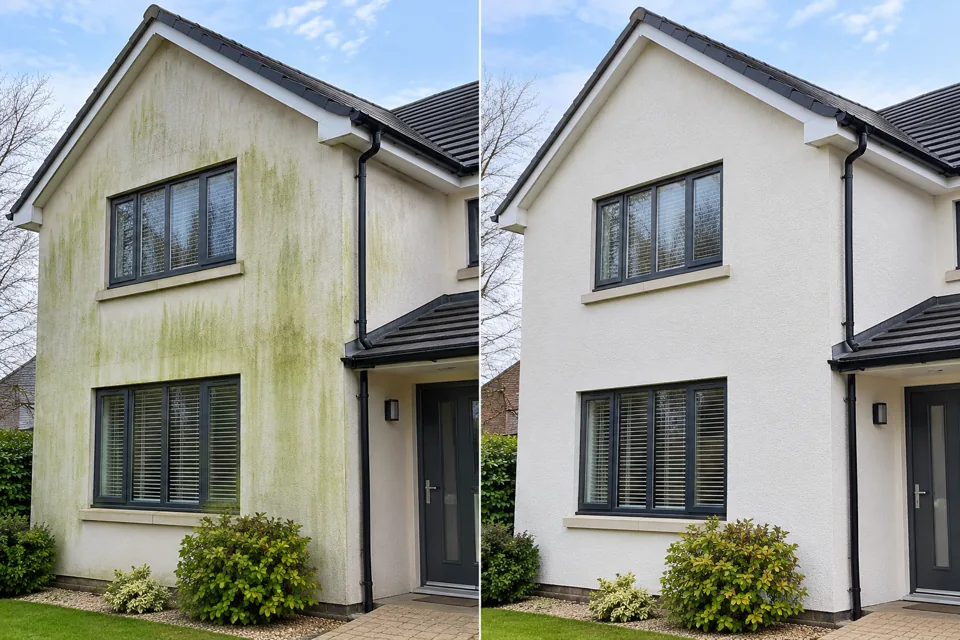
 Illustrative comparison; not a verified customer job.
1. Identify the finish and check for defects
Check whether you have K Rend silicone render, monocouche, dry dash, painted cement render or a traditional finish. Photograph cracks, hollow or loose areas, staining below gutters, and any sensitive surfaces. Damage should be resolved before wet treatment.
2. Plan safe access and protect the surroundings
Consider the wall height, balconies, neighbouring property, vegetation, pets, drains and nearby water. Do not climb unstable ladders or apply chemicals without understanding the product’s safety instructions.
3. Test and clean gently
Follow the exact render manufacturer’s and product label’s instructions. K Rend permits a washer on low-power fan settings with clean water and a small amount of mild detergent for suitable systems; it warns that very high pressure may damage the finish. A specialist may instead use low-pressure treatment for organic staining.
4. Treat algae only when suitable
K Rend lists algaecide or biocide treatment as an option for algae. Such products must be used in accordance with their label, including dilution, contact time, run-off and weather restrictions. Professional-only products should be left to appropriately trained operators.
5. Inspect and maintain
Check the finish once fully dry and record any remaining patches. Revisit overflowing gutters, trapped moisture or heavy shade; otherwise growth may return. There is no fixed cleaning interval for every building.
Check K Rend’s official maintenance guidance ↗ for your exact render.
Helpful answers from manufacturer and UK industry guidance
Short answers with links to check the supporting guidance.
Can I clean K Rend myself?
Some light maintenance may be manageable from safe ground level using manufacturer-compatible methods, but avoid ladders, uncontrolled spray and untested chemicals. K Rend recommends a gentle fan application rather than high power. Large walls, high elevations or uncertain render finishes are safer to assess professionally.
How do you remove green algae from K Rend?
First check that the wall is sound and identify the render. K Rend advises using an appropriate algae cleaner or biocide where organic growth is present, following the product directions. The surface may then need gentle cleaning or rinsing as specified; surrounding plants, drains and sensitive materials must be protected.
How often should K Rend be cleaned?
There is no universal interval for every home. K Rend advises occasional light maintenance and notes that cleaning may be useful after a few years. A shaded or damp elevation may need attention sooner than a dry, exposed wall. Watch the surface condition rather than rely on a ten-year schedule.
Frequently Asked Questions
Does K Rend recommend cleaning every 8–10 years?
No universal 8–10-year interval was found in the manufacturer’s maintenance guidance. K Rend states that cleaning may be appropriate after a few years and that maintenance depends on conditions.
Can I use a jet washer on K Rend?
K Rend allows gentle low-power fan washing on suitable finishes, but warns that very high pressure can damage the render. Check the exact product guidance first.
Should I use household bleach?
Do not improvise concentrations or apply unapproved chemicals. Use compatible, labelled products and professional advice where needed.